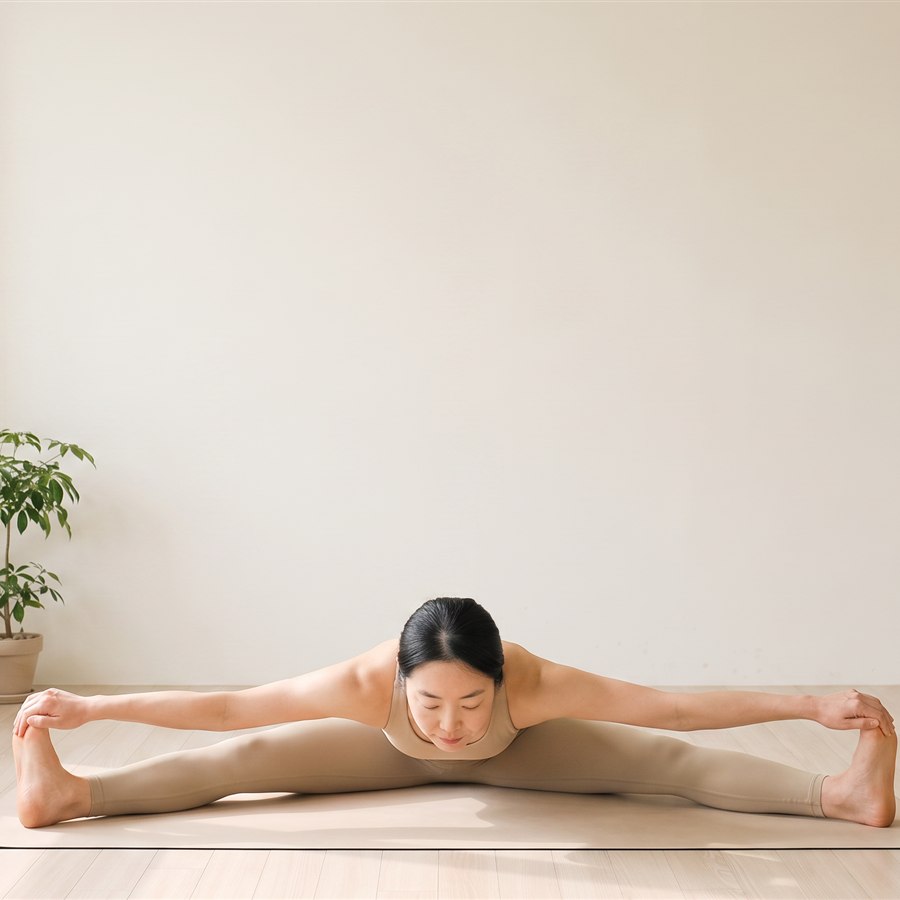
Wide-Angle Seated Fold · Upavistha Konasana
Upavistha Konasana · 우파비스타 코나사나 · 다리 벌려 전굴
Primary Series · Yoga Chikitsa (Yoga Therapy) — Seated Sequence
Breath: 5×2 · Drishti (gaze): nose · up
Legs wide with kneecaps and toes to the sky, hinge from the pelvis and catch the feet's edges. Then the lifted B variation balances the same shape in the air on the sitting bones — adductors and hamstrings opening across the full angle.
Alignment
- Hands — two fingers hook the big toes (or hold the foot edges), arms lengthening
- Feet — spread wide and flexed, toes and kneecaps pointing straight up
- Knees — facing the ceiling, the legs never rolling inward
- Gaze — the third eye; in B, upward as the legs lift
Entering the pose
- Open the legs to an honest width
- Knees and toes pointing skyward
- Exhale, hinge forward from the pelvis
Common mistakes
- The legs rolling in, kneecaps facing down
- Chasing width through inner-knee pain
Modifications & props
- Ninety degrees is a perfectly good starting width — your angle is the one where knees and toes still face the sky.
- In A, hold shins or ankles first; move the hands outward only after the fold begins from the pelvis.
- For B, a wall just behind the back lets you lift the legs and find the balance point safely.
Benefits
- Stretches adductors and hamstrings at a wide angle
- Teaches folding from an upright pelvis
- Completes the release of the legs' back line
Role in the sequence
The legs that pressed sole-to-sole in Baddha Konasana now open to their widest angle. Its A-and-B structure — seated fold, then the same shape balanced in the air — passes through one angle twice: once in release, once in strength. B's lifted balance is direct rehearsal for Supta Konasana's roll-and-balance and for Ubhaya Padangusthasana soon after.
Practice notes
Upavistha means seated, kona means angle: the angle made by the legs while sitting, a wide-legged forward fold. The folds of the Primary Series have been widening steadily to reach this point, and this is their final expansion. Around ninety degrees between the legs is usually plenty — spreading further does not make the fold deeper.
There are two stages. A takes the outer edges of both feet and sends the chest toward the floor in front for five breaths; B sits up, lifts the legs into a balance and gazes upward for five more. B asks for the exact opposite of A — contracting instead of lengthening — so it quietly checks whether the hamstrings you just stretched can still work.
Whether the kneecaps face the ceiling decides how honest this pose is. Opening the legs invites the thighs to roll inward so the knees turn toward the floor, and folding from there loads the backs of the knees and their ligaments. Two checks: do the kneecaps and toes point the same way, upward, and is the belly moving toward the floor, or only the forehead? A fold that lands the forehead first looks deep but is only a rounded back.
A blanket under the pelvis transforms this fold.
Written by Choi Seongjin — 20 years of Ashtanga practice, currently teaching three classes a week. Last updated: .
This guide is for general information and is not medical advice. If you are pregnant, injured, or have a medical condition, consult a qualified teacher or physician before practising. Disclaimer & Legal Notice
Other poses in this sequence
Ashtanga Shala — Ashtanga Vinyasa Yoga guide · Blog
Policies