Staff Pose · Dandasana
Dandasana · 단다사나 · 지팡이 자세
Primary Series · Yoga Chikitsa (Yoga Therapy) — Seated Sequence
Breath: 5 · Drishti (gaze): nose tip
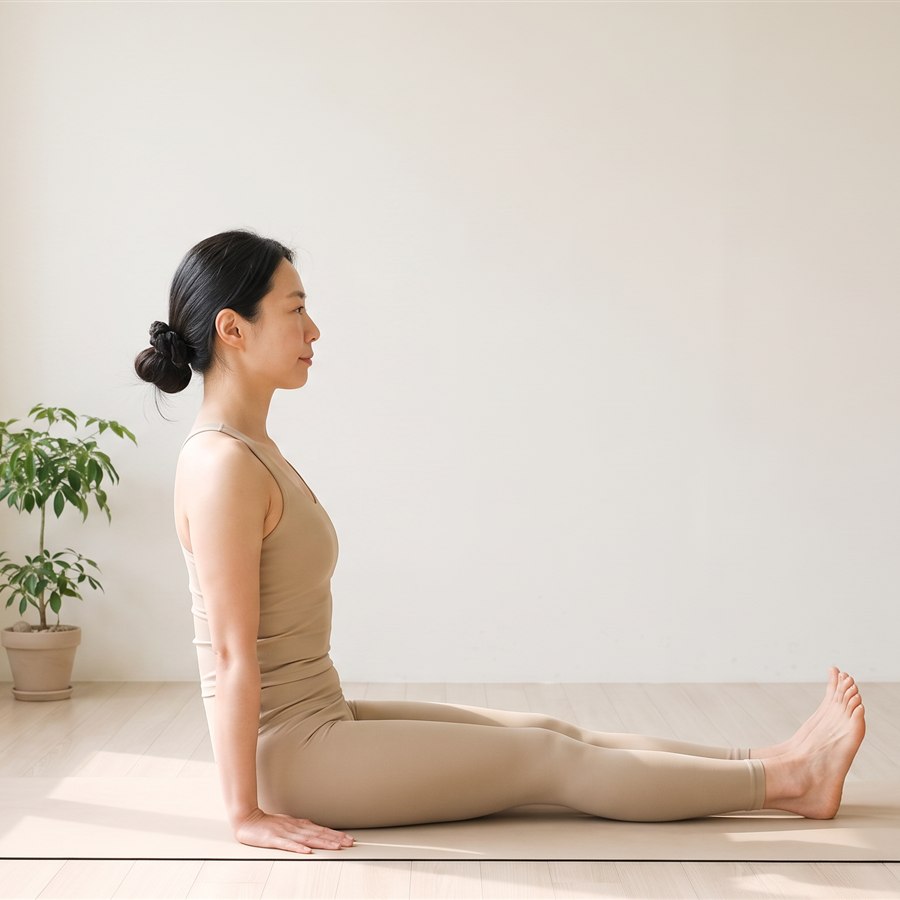
Legs together and extended, palms pressing the floor beside the hips, spine stacked vertical. Flexed feet and grounded thighs make the body straight as a staff — the alignment every seated pose departs from and returns to.
Alignment
- Hands — whole palms pressing the floor beside the hips, levering the spine tall
- Feet — together and flexed, toes drawing back toward the body
- Knees — the backs of the knees press down, waking the whole back line of the legs
- Gaze — the nose tip, chin slightly drawn in to lengthen the neck
Entering the pose
- Legs together, extended forward
- Press the floor, lift the spine
- Flex the feet, draw the chin slightly in
Common mistakes
- The pelvis tucking, lower back rounding
- Shoulders lifting, neck shortening
Modifications & props
- If the pelvis tucks under, sit on a folded blanket — in this pose the prop is the tradition.
- With proportionally short arms, press through the fingertips instead of flat palms to keep the spine's lift.
- Sitting against a wall — head, shoulder blades, sacrum touching — stores the body's own definition of straight.
Benefits
- Imprints the alignment every seated pose is measured against
- Wakes the spinal erectors and core
- The starting point for undoing slouched sitting
Role in the sequence
The first shape made the moment the jump-through lands, and the ruler against which the whole seated sequence is measured. Every seated pose effectively departs from Dandasana and returns to it, so if its vertical spine collapses, every fold that follows begins from a rounded back. Unglamorous — and the most often repeated shape in the seated section.
Practice notes
Danda means staff or stick. Sitting with the legs straight and the spine upright is the simplest-looking shape in yoga and is in fact the baseline for every seated pose that follows. Paschimottanasana, Marichyasana and the rest all depart from this form, so how the spine stacks here sets the quality of the entire seated sequence.
In the count you land here through the jump-through at the end of the Sun Salutations and stay five breaths. The palms press the floor beside the hips, the shoulders roll back and down, the chin draws in slightly and the gaze falls to the nose tip. Nothing appears to happen in those five breaths, yet this is the first place you can verify whether uddiyana bandha and mula bandha are genuinely working.
Short hamstrings roll the pelvis backwards and round the lower back, and the staff becomes a bow. A folded blanket under the sitting bones is the honest answer — after a few months the blanket gets thinner by itself. Two things to check: are the feet upright with toes drawing back toward you, and are the hands pressing the floor so the torso keeps growing upward?
Sit on a blanket if the pelvis tucks under.
Written by Choi Seongjin — 20 years of Ashtanga practice, currently teaching three classes a week. Last updated: .
This guide is for general information and is not medical advice. If you are pregnant, injured, or have a medical condition, consult a qualified teacher or physician before practising. Disclaimer & Legal Notice
Other poses in this sequence
Ashtanga Shala — Ashtanga Vinyasa Yoga guide · Blog
Policies