Bound Angle A·B · Baddha Konasana A·B
Baddha Konasana A·B · 받다 코나사나 · 나비 자세
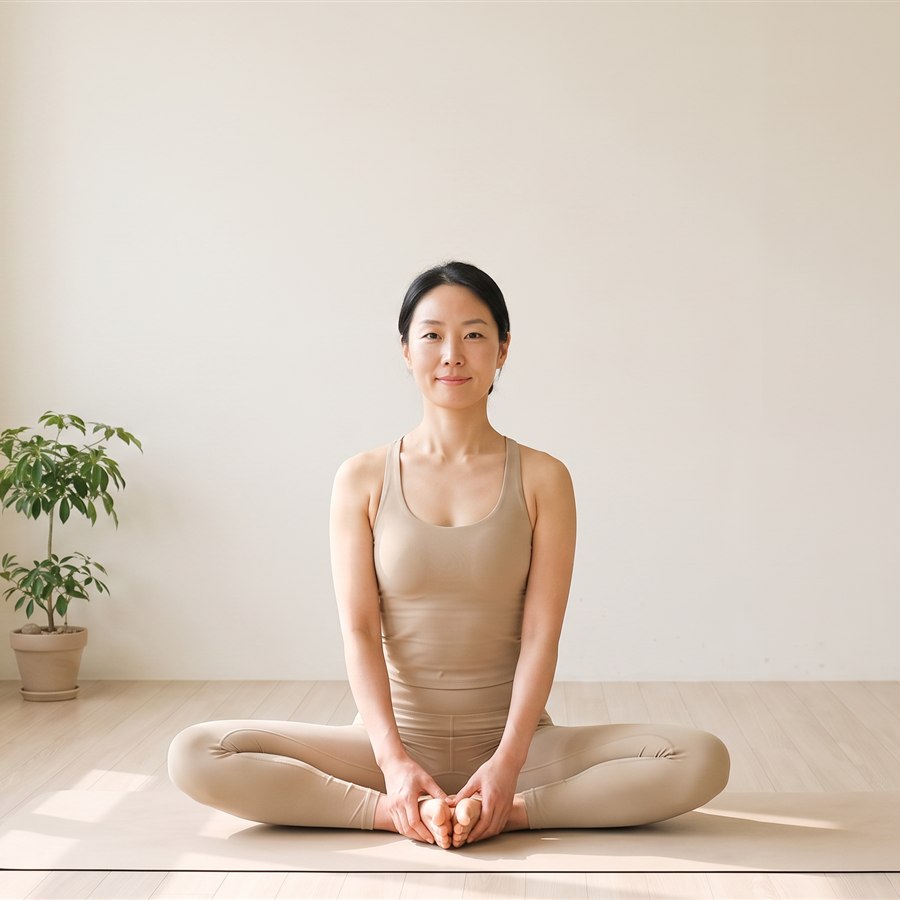
Primary Series · Yoga Chikitsa (Yoga Therapy) — Seated Sequence
Breath: 5×2 · Drishti (gaze): nose tip
Soles together, heels drawn close, feet opened like a book while the spine stays tall. A folds from the hips with the chin reaching forward; B rounds the back to bring the crown toward the feet — never pressing the knees, letting breath open the inner hips.
Alignment
- Hands — both hands open the feet like a book, elbows near the inner thighs
- Feet — soles pressed together, heels drawn close to the perineum
- Knees — never forced; they lower toward the floor on each exhale
- Gaze — the nose tip (in B, the crown releases toward the floor beyond the feet)
Entering the pose
- Soles together, heels drawn close
- Open the feet like a book
- Inhale lengthen, exhale fold
Common mistakes
- Pressing the knees down with the hands
- Rounding and leading with the head
Modifications & props
- High-floating knees ask for heels a little farther from the perineum — the gentler angle lets them descend.
- Blocks or blankets under both knees give the legs' weight somewhere to rest, and the inner thighs release first.
- If B's rounded fold troubles the lower back, stop at A's flat fold and complete the breath count there.
Benefits
- Opens the inner hips and adductors
- Supports circulation around the pelvis
- Restores hips stiffened by chair living
Role in the sequence
After the commotion of rolling and lifting, the sequence enters a quiet passage that faces the hips directly. Baddha Konasana opens it — the sole-to-sole shape traditionally described as supporting circulation through the pelvis. The adductor and external-rotation opening made here pre-builds half the angle that Upavistha and Supta Konasana are about to request.
Practice notes
Baddha means bound, kona means angle: the angle made by the soles pressed together and held by the hands. In India it also carries the name of the pose a cobbler sits in to work. It is easily mistaken for a knee-pressing pose, but the joint that actually has to open is the hip, not the knee.
A holds five breaths with the spine upright; B brings the chin or forehead to the floor in front of the feet for another five. Rounding the back and leading with the head into B leaves the hips exactly where they were and stretches only the lower back. The order of folding never changes: the pelvis tips first and the torso follows as a consequence.
Change over the months shows up not as lower knees but as heels drawing closer to the body. Pushing the knees down with the hands is a particularly costly habit, because before the hips are ready every bit of that force lands in the inner knee ligaments. Two checks: are the soles opening upward like a book, and is the chest open rather than the shoulders rolling forward? The knees come down on their own, given time.
Never press the knees down — let breath do the opening.
Written by Choi Seongjin — 20 years of Ashtanga practice, currently teaching three classes a week. Last updated: .
This guide is for general information and is not medical advice. If you are pregnant, injured, or have a medical condition, consult a qualified teacher or physician before practising. Disclaimer & Legal Notice
Other poses in this sequence
Ashtanga Shala — Ashtanga Vinyasa Yoga guide · Blog
Policies