Reverse Plank · Purvottanasana
Purvottanasana · 푸르보타나사나 · 몸 앞면 늘이기
Primary Series · Yoga Chikitsa (Yoga Therapy) — Seated Sequence
Breath: 5 · Drishti (gaze): nose tip (back)
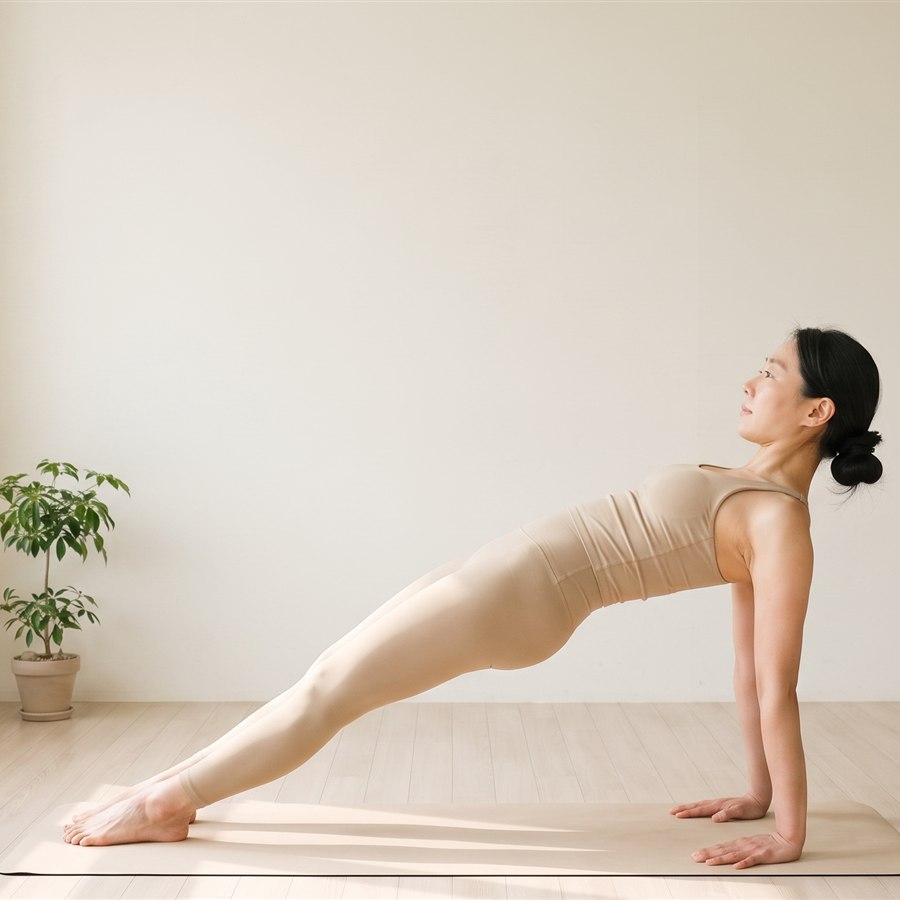
Plant the hands behind the hips, stretch the soles toward the floor, and lift the pelvis until the front body opens in one line from toes to chest. The exact counter to all the folding — and a builder of shoulder and wrist support.
Alignment
- Hands — under the shoulders, fingers pointing toward the feet, pressing the floor away
- Feet — together, insteps reaching so the whole sole works toward the floor
- Knees — legs straight, inner lines squeezing, hips lifting high
- Gaze — the head releases back, toward the nose tip behind
Entering the pose
- Hands one palm-length behind the hips
- Exhale, lift the pelvis as high as you can
- Reach the soles toward the floor, head back
Common mistakes
- The hips sagging mid-line
- Dropping the head back with no control
Modifications & props
- Lifting into table-top with bent knees and flat feet teaches the same front-body stretch and shoulder support.
- If the wrist angle bites, turn the fingers slightly outward to scatter the load.
- Take the head back only when the neck agrees — holding with the chin gently drawn keeps the pose whole.
Benefits
- Opens the whole front body after all the folding
- Strengthens shoulders, arms, wrists, and the back line
- Expanding chest and throat counters rounded shoulders
Role in the sequence
The exact counter-pose placed immediately after Paschimottanasana. Its name — stretching the east, the front body — was coined to pair with the previous pose, unfolding the body at once and returning the spine to neutral. One fold, one extension: no pair in the sequence shows Ashtanga's pose-and-counter-pose principle more plainly.
Practice notes
Purva means east — the front of the body, the side that faces the rising sun. It pairs with pashcima, the west or back body, which is why this pose follows immediately after Paschimottanasana. You have just lengthened the back; now you lengthen the front. Ashtanga's whole logic of sequencing is visible in this one pair.
Inhale to place the hands about a foot behind the hips with the fingertips pointing toward the feet, then inhale again to lift the pelvis. Through the five breaths the soles should be flat on the floor; toes down with heels floating usually means the hips have not risen far enough. The head goes back last and only as far as the neck is comfortable — dropping it first tightens the shoulders and the chest never opens.
This is one of very few pure backbends in the Primary Series and close to the only place the shoulders open backwards. For shoulders that spend the day rounded forward, five breaths can feel short. Two self-checks: have the hips sagged below the knees, and if the wrists ache, have you tried turning the fingertips slightly outward? On a low-energy day, holding the bent-knee tabletop version for the full five breaths is entirely enough.
A table-top lift is a fine substitute.
Written by Choi Seongjin — 20 years of Ashtanga practice, currently teaching three classes a week. Last updated: .
This guide is for general information and is not medical advice. If you are pregnant, injured, or have a medical condition, consult a qualified teacher or physician before practising. Disclaimer & Legal Notice
Other poses in this sequence
Ashtanga Shala — Ashtanga Vinyasa Yoga guide · Blog
Policies