Three-Limbed Forward Fold · Triang Mukha Eka Pada Paschimottanasana
Triang Mukha Eka Pada Paschimottanasana · 트리앙 무카 에카파다 파스치모타나사나
Primary Series · Yoga Chikitsa (Yoga Therapy) — Seated Sequence
Breath: 5 · Drishti (gaze): toes
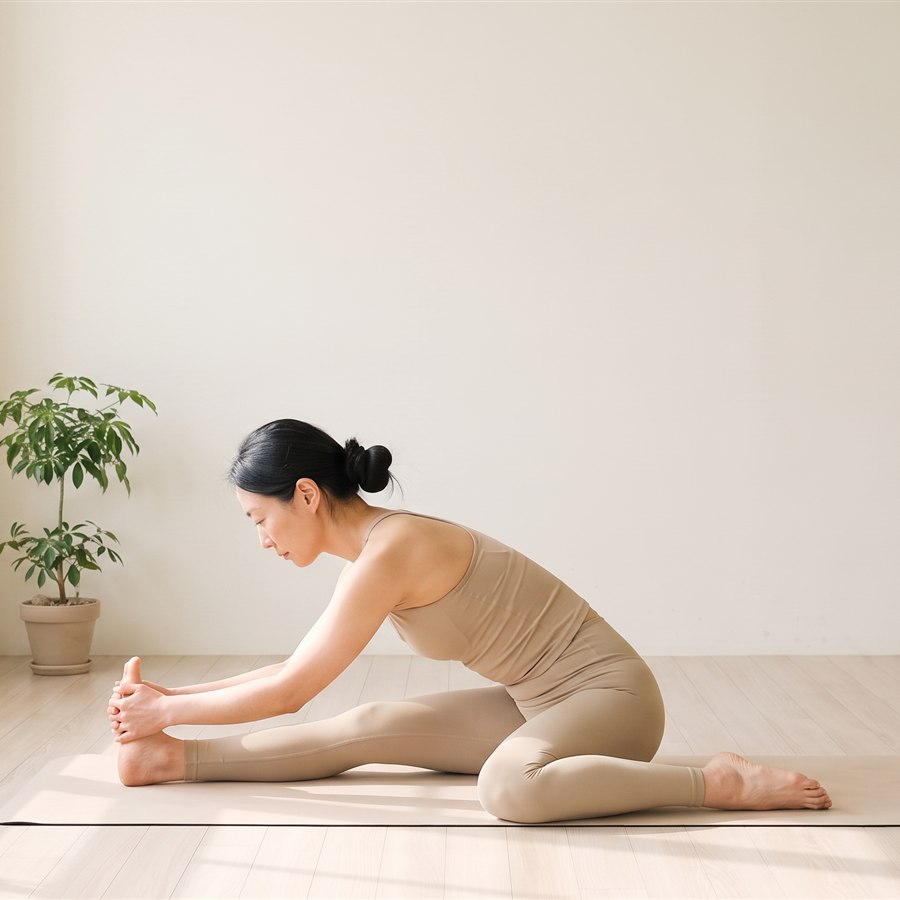
Fold one leg back so the foot rests beside the hip, ground both sitting bones evenly, and fold over the extended leg. Resisting the tilt toward the folded side is the real work — front ankle and thigh lengthen while left-right imbalance shows itself clearly.
Alignment
- Hands — both hands hold the extended foot, wrapping to the wrist as the fold deepens
- Feet — the folded foot's instep on the floor pointing straight back; the long foot flexed
- Knees — both knees drawn together, weight shared so the folded-side sit bone stays down
- Gaze — the toes, the torso centered over the straight leg
Entering the pose
- Fold the right leg back, foot beside the hip
- Ground both sitting bones evenly
- Exhale, fold over the straight leg
Common mistakes
- The folded-side hip lifting, body tilting
- The folded knee splaying wide
Modifications & props
- A folded blanket under the tilting sit bone is this pose's single most important use of a prop.
- If the folded ankle's front complains, roll a towel beneath it or shallow the fold.
- When the bent knee drifts wide, a block between the thighs restores the feeling of two parallel legs.
Benefits
- Stretches the folded leg's front ankle and thigh
- Reveals and corrects pelvic imbalance
- Teaches sitting evenly through both sit bones
Role in the sequence
The second asymmetric fold, following half lotus — this time the leg folds inward, not out. Where half lotus questioned the hip's external rotation, this pose asks about internal rotation and the front ankle: two opposite questions in a row, opening the hip both ways. Its tendency to lift one sit bone also makes it most practitioners' first clear meeting with their own left-right pelvic difference.
Practice notes
Unpacked, the long name reads triang (three limbs), mukha (face), eka pada (one leg), paschimottanasana (west-side stretch). Three points — the foot, the knee, and the sitting bone — face the floor while you fold over one leg, so the name is itself the instruction. Let any one of the three lift and the pose tilts sideways immediately.
It is barely an exaggeration to say that the lifting hip is the whole pose. The body dodges the weight it cannot place and leans to the opposite side, and the fold sets crookedly. The fix is simple: put a folded blanket or towel under the hip that floats and give it a floor to sit on. Watching that folded thickness shrink over the following months is this pose's most honest progress report.
The count is: inhale to fold the leg back with the top of the foot flat beside the hip, take the extended foot with both hands, inhale to lengthen, exhale to fold, five breaths. Sharp pain on the inside of the knee means stop at once — when the foot twists outward the knee ligaments do the stretching instead. Two checks: do both feet point in the same direction, and is the torso centred over the straight leg?
A blanket under the tilting hip evens you out.
Written by Choi Seongjin — 20 years of Ashtanga practice, currently teaching three classes a week. Last updated: .
This guide is for general information and is not medical advice. If you are pregnant, injured, or have a medical condition, consult a qualified teacher or physician before practising. Disclaimer & Legal Notice
Other poses in this sequence
Ashtanga Shala — Ashtanga Vinyasa Yoga guide · Blog
Policies