Marichi's Pose C·D (twist) · Marichyasana C·D
Marichyasana C·D · 마리챠사나 C·D · 현인 자세 (비틀기)
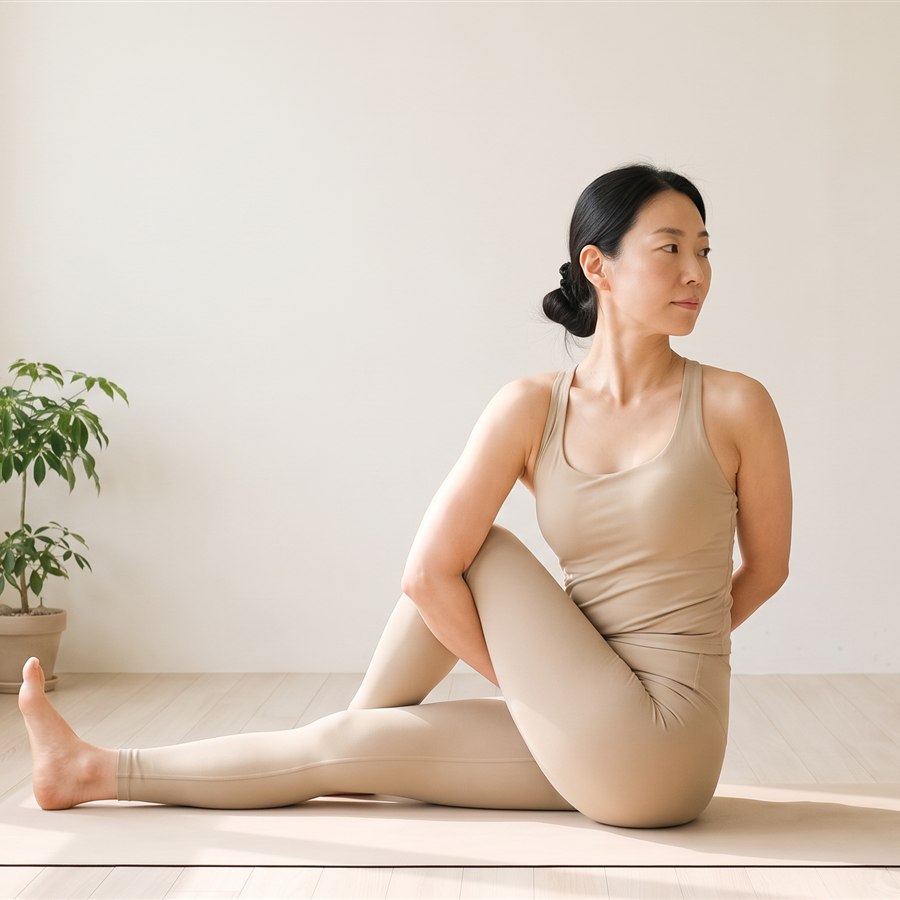
Primary Series · Yoga Chikitsa (Yoga Therapy) — Seated Sequence
Breath: 5×2 · Drishti (gaze): side
Hook the opposite elbow outside the raised knee, inhale tall, and revolve from the low belly upward with every exhale until the hands clasp behind. D repeats the spiral over a half-lotus leg — Primary's deepest twist, wringing the organs to stir circulation.
Alignment
- Hands — the opposite arm wraps outside the upright knee, hands clasping behind the back
- Feet — the upright sole fully grounded (in D balanced over a half-lotus foot)
- Knees — knee and arm press into each other so the knee stays on the midline
- Gaze — far over the turning shoulder
Entering the pose
- Knee up, inhale and lengthen the spine
- Exhale, hook the elbow outside the knee
- Deepen with each exhale, clasp behind
Common mistakes
- Twisting from a slumped spine
- Squeezing into the twist while holding the breath
Modifications & props
- C is plenty deep as an elbow-press twist without the bind — most practitioners live here for a long while.
- D belongs after half lotus, twist, and bind are each secure; until then, foot on the floor, turning as in C.
- A choked breath is the signal to unwind one notch — the exhale, not the arms, sets the twist's depth.
Benefits
- A deep spiral traveling the whole spine
- Wrings the organs, promoting circulation
- Releases the stiff mid-back
Role in the sequence
Marichyasana's twisting pair, and the deepest rotation in the Primary series. The lengthen-then-turn skill of the Parivrtta poses meets binding here, and by D — revolving and binding over a half lotus — it becomes one of Primary's hardest shapes. Tradition describes this pair as stoking the digestive fire, and structurally it bends the seated section's fold-heavy current in a new direction midstream.
Practice notes
The second pair under the sage's name twists rather than folds. In C one knee stands, the opposite elbow hooks outside it, the torso rotates, and the hands clasp behind the back; in D the other leg is in lotus while the same rotation is made. D is often named among the hardest poses in the Primary Series, and many practitioners live with it for months.
The order of a twist never changes: inhale to draw the spine long, exhale to rotate. Adding rotation on an inhale only inflates the ribs and locks the turn. The angle that lets the elbow hook outside the knee exists only once the shoulder has crossed past the knee, so if it has not, placing the elbow inside the knee for the five breaths is the better practice. The turn must come from the thoracic spine, not the lower back.
Progress here is not measured by the clasp but by how still the sitting position stays. Lifting one buttock to reach the bind leaks the rotation into the pelvis and the spine barely turns at all. Two checks: are both sitting bones still on the floor, and when the gaze travels over the shoulder, does the chest turn before the neck does?
An elbow-press twist without the bind is plenty.
Written by Choi Seongjin — 20 years of Ashtanga practice, currently teaching three classes a week. Last updated: .
This guide is for general information and is not medical advice. If you are pregnant, injured, or have a medical condition, consult a qualified teacher or physician before practising. Disclaimer & Legal Notice
Other poses in this sequence
Ashtanga Shala — Ashtanga Vinyasa Yoga guide · Blog
Policies