Warrior II · Virabhadrasana B
Virabhadrasana B · 비라바드라사나 B · 전사 2
Primary Series · Yoga Chikitsa (Yoga Therapy) — Standing Sequence
Breath: 5 · Drishti (gaze): front hand
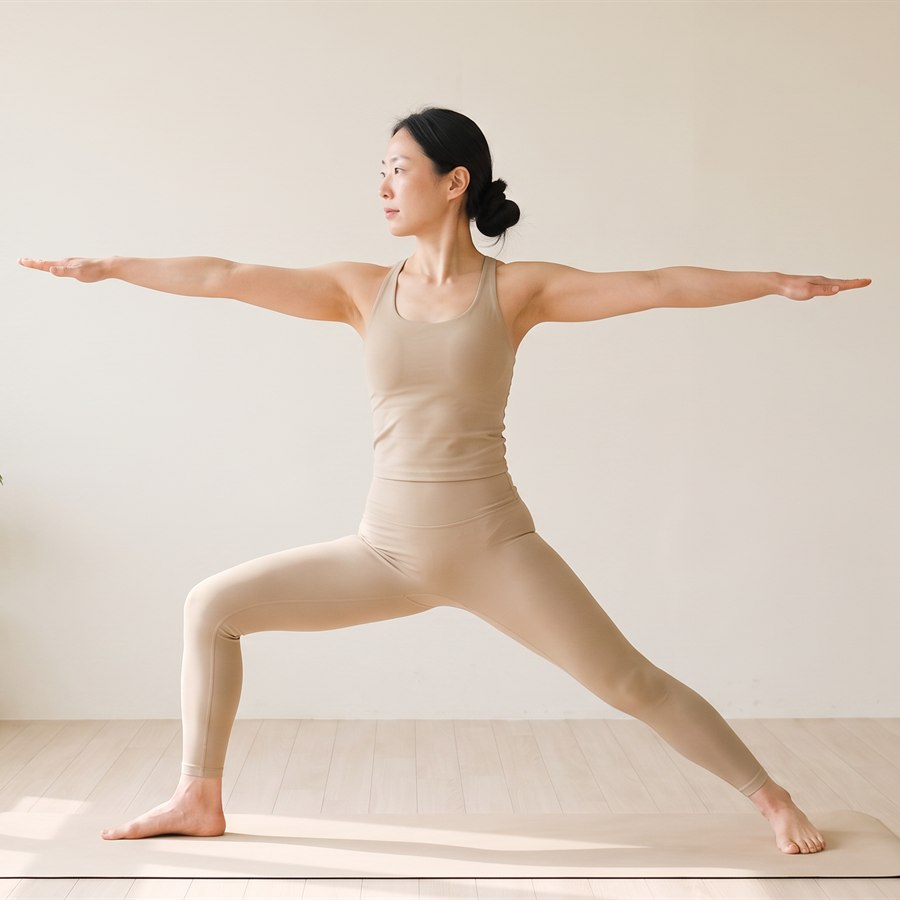
From warrior one, open the hips and chest to the side and stretch the arms level at shoulder height. Center the torso between the legs, keep the front knee over the ankle, and hold quietly, gazing far beyond the front fingertips.
Alignment
- Hands — arms stretched long at shoulder height, palms facing down
- Feet — front foot at 90°, back foot slightly in, front heel bisecting the back arch
- Knees — the front knee bends to a right angle, tracking over the second toe
- Gaze — quietly past the front fingertips into the distance
Entering the pose
- From warrior I, open the hips and chest
- Arms to shoulder height
- Gaze past the front fingers, torso centered
Common mistakes
- The torso leaning over the front leg
- The front knee caving inward
Modifications & props
- If five breaths feel long, a slightly shallower knee held for the full count beats a deep bend that folds at three.
- For achy shoulders, turn the palms forward instead of down — the arms keep their height while the trapezius lets go.
- When the back leg's inner line sags, one cue is enough: press the floor away through the outer edge of the back foot.
Benefits
- The classic lateral hip opener
- Evenly strengthens inner and outer thighs
- The steady far gaze trains a steady mind
Role in the sequence
The pose that closes the standing sequence. The pelvis and chest that faced forward in A now open wide to the side, resolving in one shape the two directions all the standing poses have built — squared and open. From its final breath the hands come down and the jump-back into the seated sequence follows directly, which is why it is traditionally called both the period at the end of standing and the wind-up for sitting.
Practice notes
Virabhadra is the warrior born from a lock of Shiva's hair. Where A lifts both arms overhead and looks up, B spreads the arms wide and gazes over the front fingertips. They are two moments of the same warrior, so Ashtanga links them into one flow: finish both sides of A, lower the arms, and step straight into B.
Through the five breaths the body works in two directions at once. The front knee folds to ninety degrees and sinks toward the floor while the back leg pushes the opposite way, straight and long. When those two forces lose their balance the torso tips forward, and the neutral pelvis this pose trains disappears. The torso belongs exactly midway between the feet, shoulders stacked over the hips.
The most common misreading of progress is treating a deeper front knee as an achievement. A knee that travels past the ankle looks deeper but is a poor bargain for the joint. Two self-checks: is the ankle directly under the front knee, and is the outer edge of the back foot still down rather than peeling up? Keep the arms strong at shoulder height and the shoulders far from the ears.
Lower the arms slightly if the shoulders grip.
Written by Choi Seongjin — 20 years of Ashtanga practice, currently teaching three classes a week. Last updated: .
This guide is for general information and is not medical advice. If you are pregnant, injured, or have a medical condition, consult a qualified teacher or physician before practising. Disclaimer & Legal Notice
Lessons on this posture
Other poses in this sequence
Ashtanga Shala — Ashtanga Vinyasa Yoga guide · Blog
Policies