Warrior I · Virabhadrasana A
Virabhadrasana A · 비라바드라사나 A · 전사 1
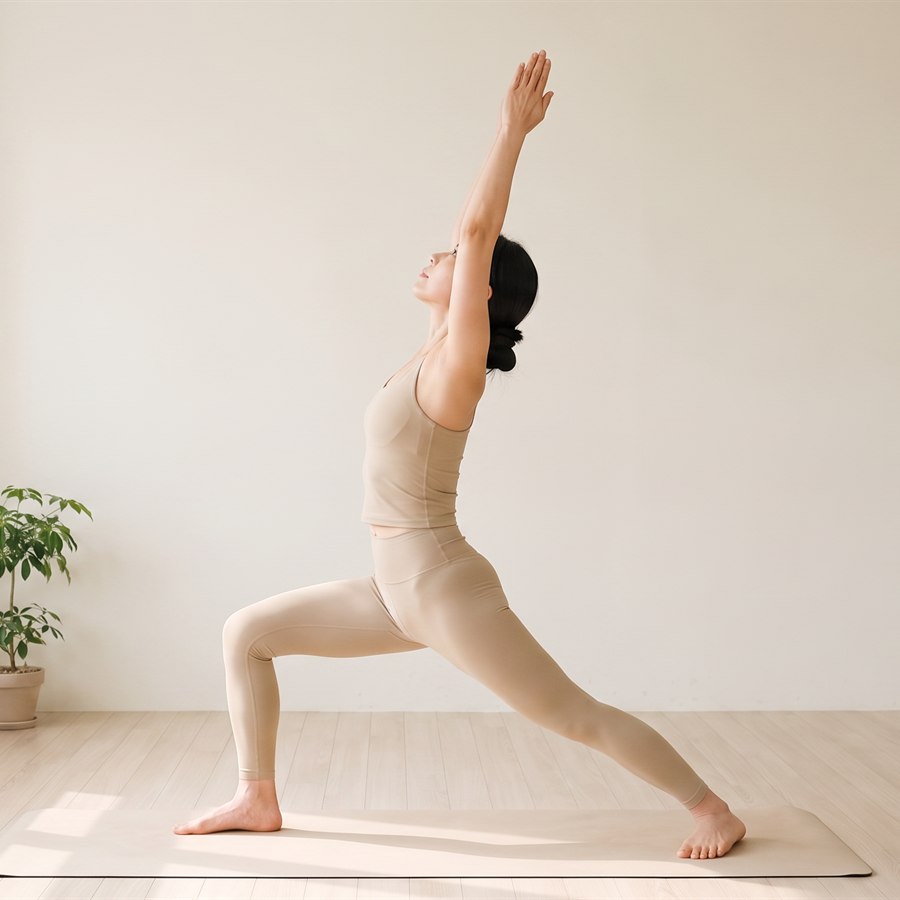
Primary Series · Yoga Chikitsa (Yoga Therapy) — Standing Sequence
Breath: 5 · Drishti (gaze): thumbs
From a long stance with the back foot flat at forty-five degrees, square the hips forward and bend the front knee to a right angle. Join the palms overhead and lift the chest toward the thumbs — the back hip's front opens long while the legs gather strength.
Alignment
- Hands — palms sealed overhead, elbows straight, little-finger edges spiraling together
- Feet — the back foot flat at 45°, front and back heels aligned on one line
- Knees — front knee at a right angle over the ankle; the back leg strong and straight
- Gaze — the thumbs, lifting the chest without flaring the ribs
Entering the pose
- Long stance, back foot at 45°
- Square the hips forward
- Exhale bend the knee, inhale reach up
Common mistakes
- The back foot-edge lifting, twisting the knee
- Bracing by over-arching the lower back
Modifications & props
- If the pelvis won't square, step the back foot toward the mat's edge — standing on two rails, not one tightrope.
- The ninety-degree front knee is a destination; a shallower lunge over a strong back leg beats a deep one that has collapsed.
- Reaching up with the hands shoulder-width apart, rather than joined, reduces the over-arch in the lower back.
Benefits
- The archetype of lower-body strength and stamina
- Stretches the back leg's hip flexors
- The lifted chest builds an upright, confident carriage
Role in the sequence
The opening act of the standing sequence's finale, testing legs warmed by Utkatasana in an asymmetric lunge. Squaring the pelvis over a fully grounded back foot intensifies the rule first learned in Parsvottanasana. The front of the back hip that opens here is also groundwork for the entire backbend family.
Practice notes
Virabhadra is the warrior born of Shiva's wrath — one of the few asanas that borrows a mythological figure whole. Of its three variations, Ashtanga's standing sequence holds A and B, and since A also lives inside Surya Namaskara B, you have already passed through this shape several times each morning before its formal five-breath seat arrives.
In the vinyasa you inhale out of Parsvottanasana, spinning the left foot to forty-five degrees and bending the right knee as the arms rise; after five breaths you turn straight to the other side without an exhale between — a rare passage with no vinyasa separating left from right. The turn happens by transferring weight through bent legs, not by straightening first, so the thighs get no intermission.
This pose's homework remains, year after year, the back leg. The front knee's angle is visible; the back leg's collapse is easy to miss from inside. One test: press the floor through the back foot's outer edge — if the whole body seems to grow a centimeter taller, the back leg is alive; if nothing changes, you were already sitting on the front thigh.
Shorten the stance so the knee stays over the ankle.
Written by Choi Seongjin — 20 years of Ashtanga practice, currently teaching three classes a week. Last updated: .
This guide is for general information and is not medical advice. If you are pregnant, injured, or have a medical condition, consult a qualified teacher or physician before practising. Disclaimer & Legal Notice
Lessons on this posture
Other poses in this sequence
Ashtanga Shala — Ashtanga Vinyasa Yoga guide · Blog
Policies