Half-Bound Lotus Forward Fold (standing) · Ardha Baddha Padmottanasana
Ardha Baddha Padmottanasana · 아르다 받다 파드모타나사나 · 반연꽃 선 전굴
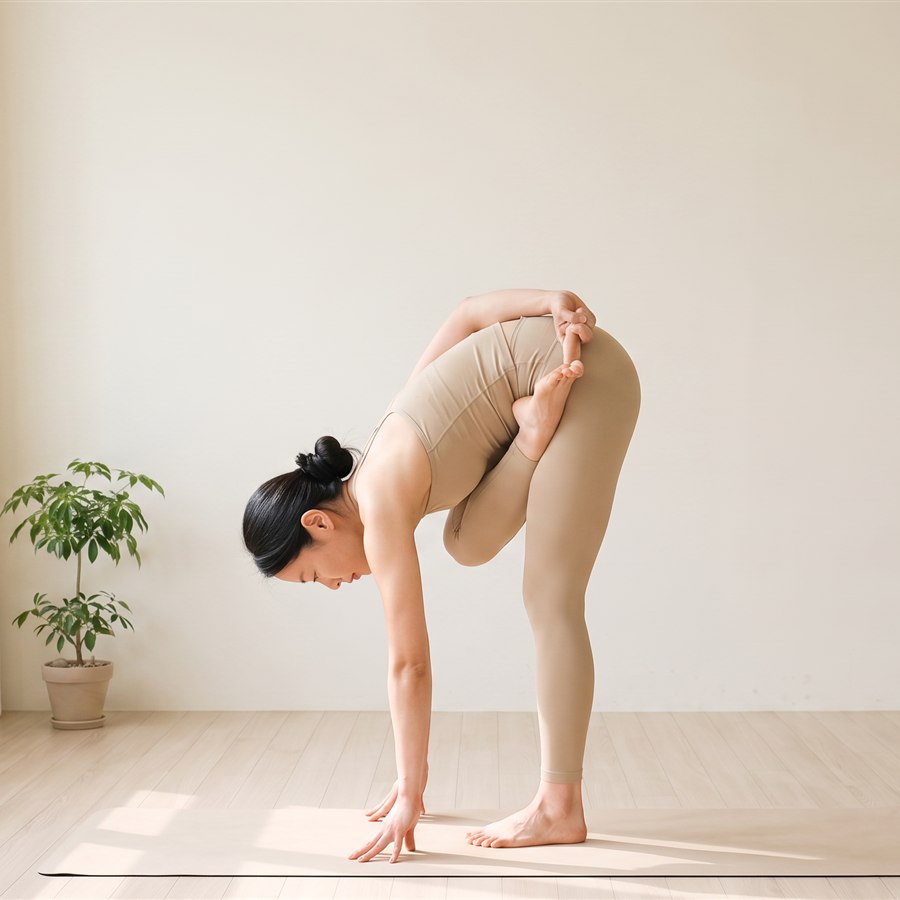
Primary Series · Yoga Chikitsa (Yoga Therapy) — Standing Sequence
Breath: 5 · Drishti (gaze): nose tip
Fold one foot high into half lotus, reach the same-side arm behind the back to bind the foot, and fold forward on one standing leg. Exhale down until the hand meets the floor, lengthening the spine on each inhale — external hip rotation, balance, and shoulder opening in a single shape.
Alignment
- Hands — the same-side arm wraps behind to bind the lotus foot; the free palm lands beside the standing foot
- Feet — the lotus foot rides high in the opposite hip crease; the standing sole presses down evenly
- Knees — the folded knee hangs toward the floor while the standing leg stays straight
- Gaze — the nose tip; if the balance wavers, fix one point on the floor
Entering the pose
- Right foot to half lotus on the left thigh
- Reach the right arm behind to bind the foot
- Exhale, fold slowly, left hand to the floor
Common mistakes
- Pushing through knee pain (release at once)
- Wrenching the shoulder to chase the bind
Modifications & props
- Safest for the knee: cradle the half-lotus foot with the opposite hand instead of binding, free hand on the waist.
- Standing and holding without folding is already half the pose — balance and hip first, the fold added last.
- If half lotus is premature, hook the ankle over the opposite thigh in a figure-four instead; the hip opens along the same line.
Benefits
- Half lotus opens the hip's external rotation deeply
- The bind behind the back stretches the front shoulder
- A one-leg fold combining balance and digestion
Role in the sequence
Half lotus makes its first appearance of the entire practice here. Every half-lotus pose scattered through the seated sequence — Ardha Baddha Padma Paschimottanasana, Marichyasana B and D — is foreshadowed in this shape. Folding on one leg while holding the bind touches all three assignments at once — balance, hip rotation, shoulder bind — before the standing section closes.
Practice notes
Ardha (half), baddha (bound), padma (lotus), uttana (intense stretch) — a half lotus, bound, folded intensely. Three tasks are already inside the name, which is why this pose sits at the end of the standing sequence. Asking for balance, lotus, and a forward fold at once makes it the most composite of all the standing shapes.
Build the lotus foot first, reach the arm behind the back to catch its big toe, inhale to lengthen, exhale to fold. After five breaths you inhale halfway up, exhale back down, and inhale all the way to standing. That final inhale — rising from a deep fold on one leg — is the hardest moment in the pose, and it is usually where a lack of standing-leg strength shows itself.
If the knee hurts, never push. Lotus comes from external rotation at the hip, not from the knee, and forcing the foot up before that rotation exists sends the entire load into the inner knee ligaments. Spending several months with the foot resting in front of the shin instead of on the thigh is, in the end, the faster road. Check two things: whether the lifted knee is drifting downward, and whether the standing knee is locked rather than softly alive.
Knee pain means release immediately — balance without the bind first.
Written by Choi Seongjin — 20 years of Ashtanga practice, currently teaching three classes a week. Last updated: .
This guide is for general information and is not medical advice. If you are pregnant, injured, or have a medical condition, consult a qualified teacher or physician before practising. Disclaimer & Legal Notice
Lessons on this posture
Other poses in this sequence
Ashtanga Shala — Ashtanga Vinyasa Yoga guide · Blog
Policies