Extended Hand-to-Big-Toe · Utthita Hasta Padangusthasana
Utthita Hasta Padangusthasana · 웃티타 하스타 파당구쉬타사나 · 선 다리 들기
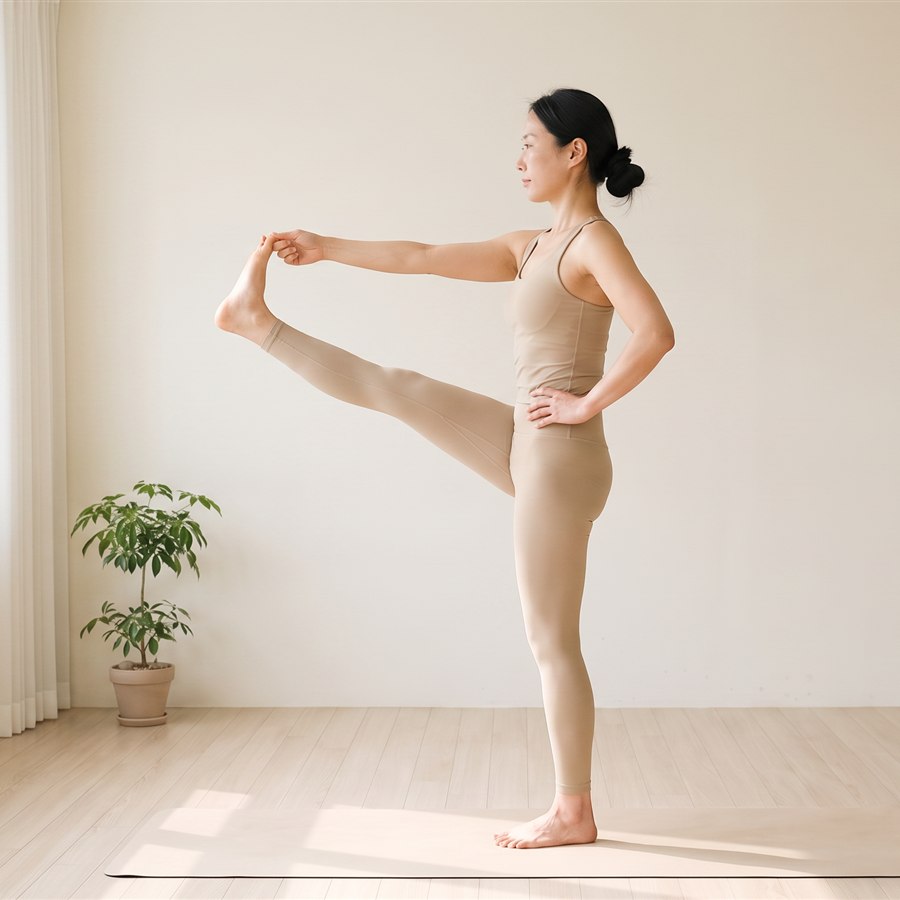
Primary Series · Yoga Chikitsa (Yoga Therapy) — Standing Sequence
Breath: 5×4 · Drishti (gaze): toes · side
Standing on one leg, hold the big toe and extend the leg forward for five breaths, open it to the side for five, then return and hold the leg up with no hand at all. The standing hip drawn under and the spine kept tall matter far more than leg height — a study in steady gaze amid wobble.
Alignment
- Hands — two fingers hook the lifted big toe; the other hand rests firmly on the waist
- Feet — the standing sole grips the floor at three points; the lifted toes reach long
- Knees — standing leg straight; the lifted leg straightens only as far as the spine stays tall
- Gaze — the lifted toes; when the leg opens sideways, far to the opposite side
Entering the pose
- Left hand to the waist, catch the right big toe
- Inhale, extend the leg forward (5 breaths)
- Open the leg to the side (5 breaths)
- Return to center, release, hold the leg up
Common mistakes
- The standing hip jutting sideways
- Rounding the back for leg height
- Staring at the floor and tensing the neck
Modifications & props
- Leg height is not the achievement — a bent-knee hold, or lifting only to thigh height, gives the standing leg identical work.
- A strap around the sole lets the leg straighten under a tall spine, which teaches more than lifting high with a rounded back.
- Touching fingertips to a wall only during the sideways phase is a fine compromise — it is where the wobble is loudest.
Benefits
- One-leg balance builds ankle and core stability
- Extends hamstring and hip mobility
- Every wobble is training for concentration
Role in the sequence
Everything practiced on two feet is now examined on one. The balance section of the standing sequence begins here, and its three phases — forward, sideways, hands-free — strung on one breath rhythm make the longest continuous balance hold in the practice. The rooting of the standing leg built here becomes the foundation for Ardha Baddha Padmottanasana, the very next pose.
Practice notes
The name says it plainly: standing, hand extended, holding the big toe. This is the first place in the standing sequence where you balance on one leg, so although it looks like a flexibility test it is really a balance test. How evenly the standing foot reads the floor matters far more than how high the lifted leg goes.
Four stages make one set — extended forward for five breaths, opened to the side for five, drawn back to centre for five, and finally the hands on the waist with the leg still lifted for five. The moment the hand lets go in that last stage you discover exactly what the first three stages were doing for you. The rule is that the standing foot never shifts position until both sides are finished.
Progress arrives in months like this: first the knee stays bent and everything wobbles; then the leg straightens but the pelvis tilts; only later does the leg rise with both hip points level. Two things to check yourself — whether the hip of the lifted leg has ridden upward, and whether the torso turns along with the gaze when the leg opens to the side. Wobbling is not failure; it is the body doing arithmetic.
Bend the knee to catch the toe, or use a strap. A wall nearby helps.
Written by Choi Seongjin — 20 years of Ashtanga practice, currently teaching three classes a week. Last updated: .
This guide is for general information and is not medical advice. If you are pregnant, injured, or have a medical condition, consult a qualified teacher or physician before practising. Disclaimer & Legal Notice
Lessons on this posture
Other poses in this sequence
Ashtanga Shala — Ashtanga Vinyasa Yoga guide · Blog
Policies