Extended Triangle · Utthita Trikonasana
Utthita Trikonasana · 웃티타 트리코나사나 · 삼각 자세
Primary Series · Yoga Chikitsa (Yoga Therapy) — Standing Sequence
Breath: 5 · Drishti (gaze): top hand
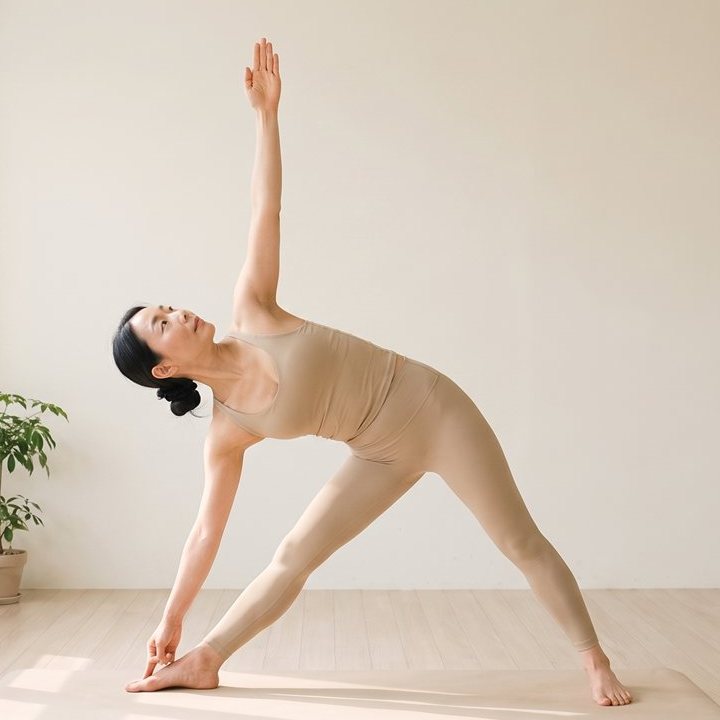
From a wide stance with the front foot turned out ninety degrees, tilt sideways in one plane and catch the big toe. Keep the hips from drifting back and turn the chest open to the sky, so the body draws one long triangle from the back foot's edge to the top fingertips.
Alignment
- Hands — the lower hand hooks the big toe with two fingers; the top arm reaches vertically, one line to the fingertips
- Feet — front foot at 90°, back foot slightly in, both heels on one straight line
- Knees — both straight; if the front knee hyperextends, micro-bend it and hold with the thigh
- Gaze — the top fingertips; if the neck complains, gaze forward instead
Entering the pose
- Step wide, arms out
- Front foot 90°, back foot slightly in
- Exhale, reach long to the side
- Lower hand to the toes, top arm skyward
Common mistakes
- Hips drifting back, torso collapsing forward
- Leaning weight into the bottom hand
- Cranking the neck to look up
Modifications & props
- Any spot on the shin is a fine handhold when the toes are far — an open chest matters before a low hand.
- A block standing outside the front foot helps you find the height where the torso stops collapsing forward.
- If the neck complains, gaze forward or down instead of up — the drishti extends only as far as the neck allows.
Benefits
- Lengthens the side body from hip to fingertips
- Builds leg strength and grounded, awake feet
- The open chest widens the space for breath
Role in the sequence
After two folds have opened the back body, the sequence turns sideways for the first time here. Trikonasana is a fundamental shared by nearly every yoga system, and the grammar learned in it — hinging at the pelvis while keeping the torso on one plane — governs the whole side-angle family that follows. Parivrtta Trikonasana, up next, pairs with it as the revolved counterpart.
Practice notes
Tri (three) and kona (angle) — the three-angle posture. Inside the large triangle drawn by the legs and floor, the arms and torso layer smaller triangles, and the silhouette is among the oldest and most recognized in yoga's iconography: whatever tradition you learned in, this shape is mutually intelligible. In Ashtanga, the parsva drishti — the gaze to the top fingertips — completes the figure.
In the vinyasa, you inhale and leap sideways from Samasthiti, opening arms and legs in one motion (ekam), then exhale to tilt right and catch the toes (dve). Five breaths, inhale up, turn the feet, exhale left — the two sides joined by single breaths. The trick to not collapsing forward on the way down is assigning the descent to the hinge of the pelvis, not the side waist.
Real progress here is not the hand nearing the floor; it is the lower flank growing as long as the upper one. If the space between bottom ribs and pelvis is crumpled, the triangle has failed even with the hand on the foot. After some months the body learns that the chest's skyward turn and the pelvis's hinge are separate events — and from then on this pose starts to feel less like holding and more like resting.
Rest the hand on the shin or a block.
Written by Choi Seongjin — 20 years of Ashtanga practice, currently teaching three classes a week. Last updated: .
This guide is for general information and is not medical advice. If you are pregnant, injured, or have a medical condition, consult a qualified teacher or physician before practising. Disclaimer & Legal Notice
Lessons on this posture
Other poses in this sequence
Ashtanga Shala — Ashtanga Vinyasa Yoga guide · Blog
Policies