Revolved Triangle · Parivrtta Trikonasana
Parivrtta Trikonasana · 파리브르타 트리코나사나 · 회전 삼각
Primary Series · Yoga Chikitsa (Yoga Therapy) — Standing Sequence
Breath: 5 · Drishti (gaze): top hand
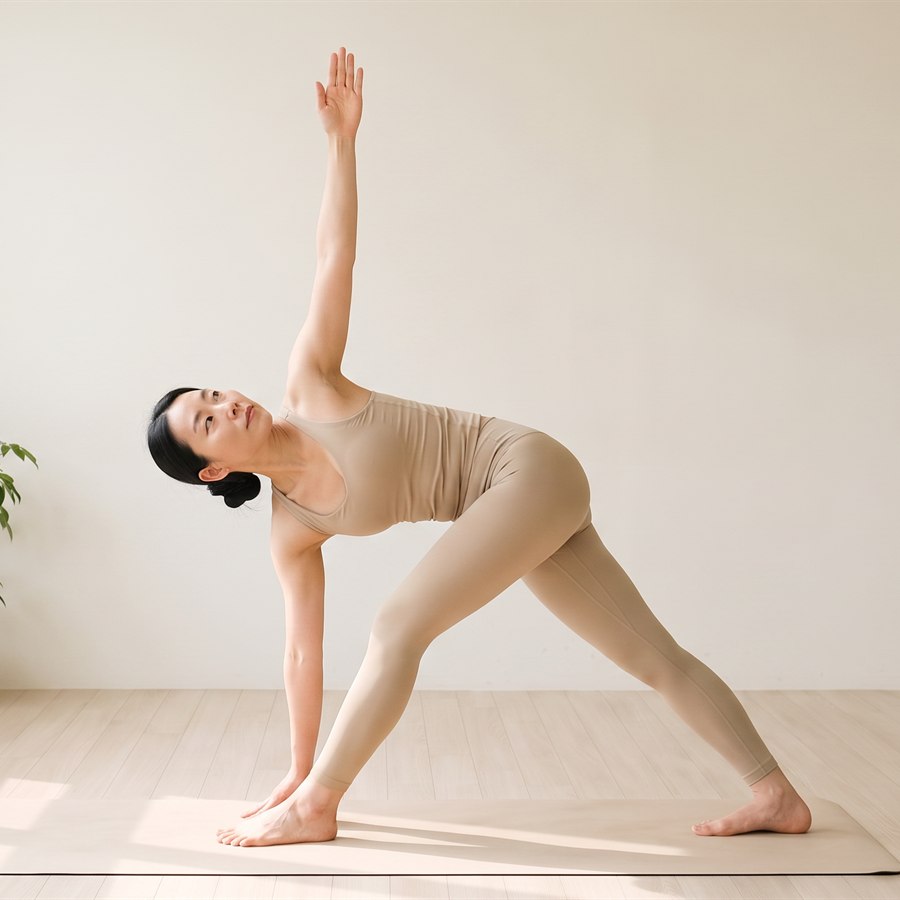
Take a slightly shorter stance, square the hips to the front leg, and revolve the torso to place the opposite hand on the floor outside the front foot. Rotate from the low belly upward while the pelvis stays fixed, then extend the top arm and let the gaze follow — rotation, balance, and hamstring stretch in one shape.
Alignment
- Hands — the opposite palm (or fingertips) to the floor outside the front foot; the top arm vertical
- Feet — a hand-span shorter stance, the back foot pinned at 45 degrees
- Knees — both legs straight while the pelvis stays squared to the front leg
- Gaze — the top fingertips; the twist begins in the low belly, not the eyes
Entering the pose
- Take a slightly shorter stance
- Square the hips toward the front leg
- Exhale, twist and place the opposite hand down
- Extend the top arm vertically
Common mistakes
- Twisting only the shoulders while the hips stay open
- The back heel lifting
- Rushing the gaze up and losing balance
Modifications & props
- Begin with the lower hand inside the foot or on a block — the quality of the rotation comes before the reach.
- When balance wobbles, shorten the stance another hand-span; this pose is steadier short than wide.
- Standing with the back near a wall and turning the top shoulder toward it teaches the body the direction of the twist quickly.
Benefits
- Trains spinal rotation and balance at once
- The twist stimulates the abdominal organs and circulation
- Hamstrings and hips lengthen together
Role in the sequence
The first twist the standing sequence offers, and the first opposite-hand-to-opposite-foot crossing of the entire practice. What Trikonasana opened sideways is now wound into rotation, teaching the spine to turn while staying long. Without this feel, deep seated twists like Marichyasana C and D tend to happen around a slumped spine.
Practice notes
Parivrtta means revolved, trikona means three angles. The name asks you to keep the triangle of the previous pose and turn only the torso, which is why the difficulty here is directional rather than muscular. The pelvis should stay facing forward while the ribs rotate, yet the body always turns the easy part first. If the back hip has swung open, the twist has already left the spine.
In the vinyasa you stand up from the second side of Trikonasana, inhale with the hands on the waist, and exhale as the opposite hand travels to the floor outside the front foot and the chest turns. Across the five breaths, inhales lengthen the spine and exhales deepen the rotation. Trying to twist on an inhale only inflates the ribs and blocks the turn — revolving is always the exhale's job.
Progress is not the lower hand reaching the floor; it is the back heel staying pressed down to the last breath. For the first months a block under that hand, with the heel protected, improves the pose far faster. Two questions to ask yourself: are the shoulders stacked in one vertical line, and are you craning the neck just to see the top hand? If the neck complains, look straight ahead and the pose is still complete.
Keep the hand inside the foot or on the shin at first.
Written by Choi Seongjin — 20 years of Ashtanga practice, currently teaching three classes a week. Last updated: .
This guide is for general information and is not medical advice. If you are pregnant, injured, or have a medical condition, consult a qualified teacher or physician before practising. Disclaimer & Legal Notice
Lessons on this posture
Other poses in this sequence
Ashtanga Shala — Ashtanga Vinyasa Yoga guide · Blog
Policies