Wide-Legged Forward Fold A–D · Prasarita Padottanasana A–D
Prasarita Padottanasana A–D · 프라사리타 파도타나사나 · 다리 넓게 전굴
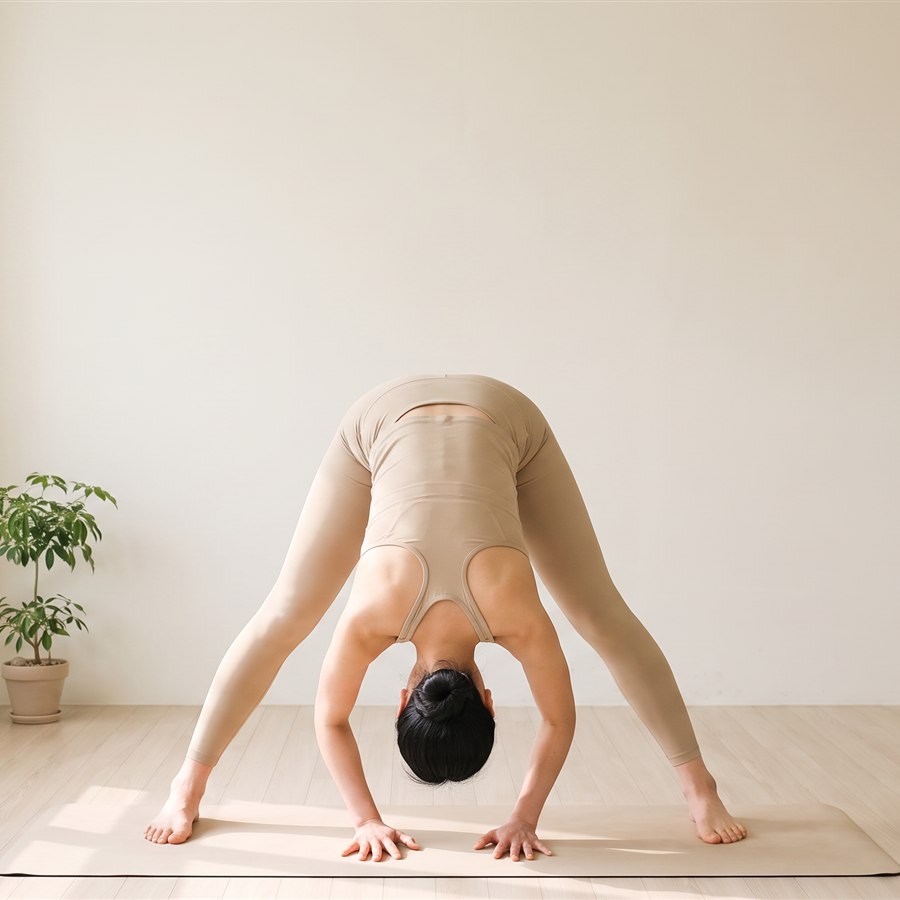
Primary Series · Yoga Chikitsa (Yoga Therapy) — Standing Sequence
Breath: 5×4 · Drishti (gaze): nose tip
With feet twice shoulder-width apart, hinge from the hips and lower the crown toward the floor. Four variations follow — hands to the floor, waist, clasped behind, and toes — five breaths each, weight kept forward so inner thighs and hamstrings open across a wide angle.
Alignment
- Hands — A: floor at shoulder width · B: on the waist · C: clasped behind · D: two fingers on the big toes
- Feet — twice shoulder-width and parallel, outer edges pressing lightly to keep the arches alive
- Knees — straight, front thighs lifting, weight drifting toward the balls of the feet
- Gaze — the nose tip, crown reaching for the floor between the feet
Entering the pose
- Feet twice shoulder-width apart
- Inhale lengthen, exhale fold
- A: hands down → B: waist → C: clasp behind → D: toes
Common mistakes
- Weight sinking back into the heels
- Rounding and pushing the head toward the floor
Modifications & props
- A block under the crown removes the strain of a head hovering in space and lets the neck go.
- In C, if the clasped arms won't travel over, hold a strap at shoulder width — forcing them over injures the front of the shoulder.
- On a day of loud hamstrings, narrow the stance slightly and soften the knees, keeping the order of the four variations intact.
Benefits
- Opens the inner thighs and hamstrings at a wide angle
- Lowering the head calms the nervous system
- The clasped arms of C release shoulders and upper back
Role in the sequence
The narrow folds turn wide here, repeated four times over — a mid-sequence stretch where the breath settles. Cycling A through D with only the hands changing shows Ashtanga's signature way of learning: one shape studied from several angles. The clasped arms of C are the shoulders' homework for the bound poses ahead.
Practice notes
Prasarita means spread out, pada is foot, uttana is intense stretch. Four variations share one name, and nowhere else in Ashtanga is a single fold repeated four times with nothing changing but the hands: A places them between the feet, B on the waist, C interlaced behind the back, D holding the big toes. With each letter the arms help the body less.
Each variation holds five breaths with an inhale to lift the head between them, which makes this the longest stop in the standing sequence and an easy place for the breath to fray. Crown to the floor is the aim in A and C only, and widening the stance to get there simply lets the pelvis drift backwards, making the fold shallower than it looks.
C is the shoulder's report card. At first the interlaced hands rest on the back; a few months later they rise a little; later still they travel past the head toward the floor. Two things to watch: whether you are hoisting the shoulders toward the ears to get there, and whether the weight stays over the balls of the feet through all four variations. A body that has retreated into its heels gets no hamstring stretch however deep the fold appears.
The crown needn't touch the floor — feel the spine lengthen.
Written by Choi Seongjin — 20 years of Ashtanga practice, currently teaching three classes a week. Last updated: .
This guide is for general information and is not medical advice. If you are pregnant, injured, or have a medical condition, consult a qualified teacher or physician before practising. Disclaimer & Legal Notice
Lessons on this posture
Other poses in this sequence
Ashtanga Shala — Ashtanga Vinyasa Yoga guide · Blog
Policies