Upward Bow (Wheel) · Urdhva Dhanurasana
Urdhva Dhanurasana · 우르드바 다누라사나 · 아치 자세
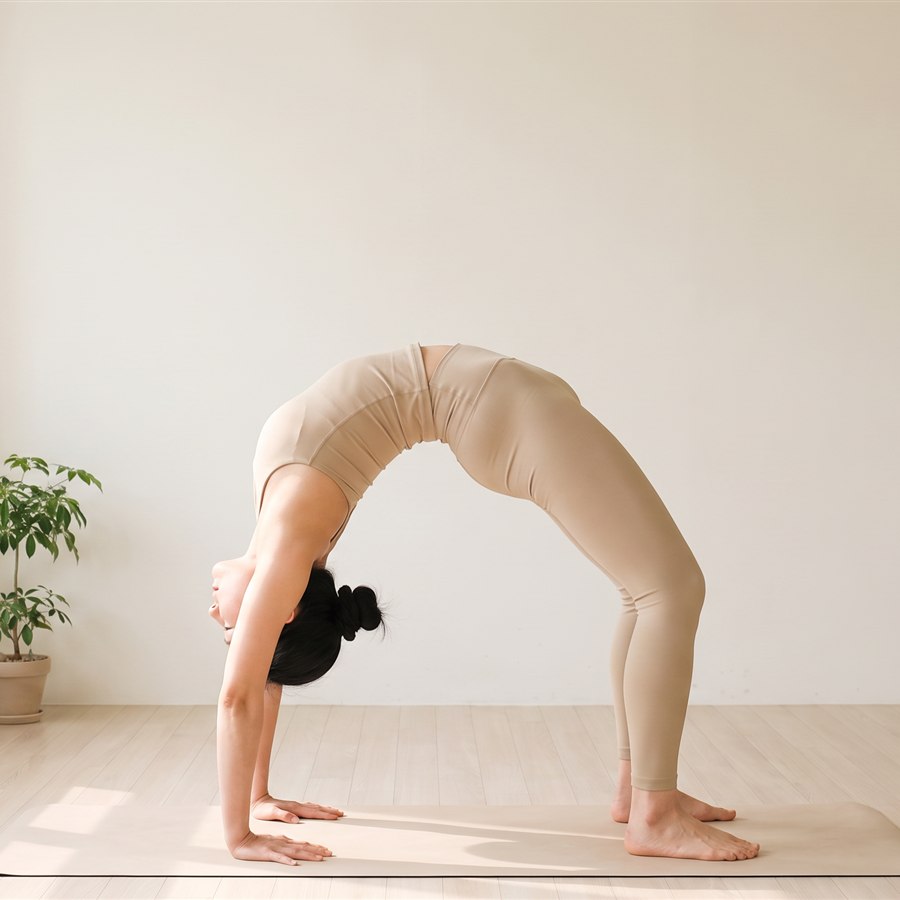
Primary Series · Yoga Chikitsa (Yoga Therapy) — Finishing Sequence
Breath: 5×3 · Drishti (gaze): nose tip
Hands by the ears, feet near the hips, press into a full arch and lower, three times. The bend must spread through shoulders, chest, and hip fronts rather than pooling in the lower back, the breath staying even through the lift.
Alignment
- Hands — shoulder-width, fingers toward the feet, every knuckle pressing evenly
- Feet — hip-width and parallel, heels staying down
- Knees — tracking over the ankles, inner thighs hugging so they don't splay
- Gaze — the floor between the hands, the head hanging free
Entering the pose
- Feet near the hips, hands by the ears
- Inhale, come to the crown briefly
- Press arms and legs to full lift
Common mistakes
- Elbows splaying outward
- Only the lower back bending, chest closed
- Descending chin-first
Modifications & props
- Treat the crown-on-floor stage as a pose in its own right — straight arms are next semester's lesson.
- If the wrist angle hurts, a wedge or folded mat under the heels of the hands softens it.
- When three rounds are too many, do one exactly — a single lift with knees and feet parallel beats three without.
Benefits
- The archetypal full backbend of the spine
- Shoulders, chest, and hip fronts all open
- A heart-opener that lifts energy and mood
Role in the sequence
The pose that opens the finishing sequence. Whichever series is practiced, the day's asana peaks with these three backbends; everything after flows toward settling. The three repetitions are by design — the first wakes the body, the second opens it, the third reaches the deepest arch — and the Paschimottanasana that follows immediately rinses the spine in the opposite direction.
Practice notes
Urdhva (upward) and dhanura (bow) — the upward-facing bow. The common name wheel is less accurate than the original picture: hands and feet are the bow's two tips, and the spine curves taut as its body. In Ashtanga this is the gateway backbend every practitioner meets daily after Primary, and further along it extends into dropbacks — rising from this arch to standing.
The traditional rhythm: inhale to press up, five breaths, exhale to lower briefly to the crown, inhale up again — three times, then straight into Paschimottanasana to rinse the spine the other way. The commonest trap is holding the breath at the moment of lifting; let the inhale itself raise the body and the same strength lifts you noticeably higher.
Months of progress show not in the arch's height but in its distribution. At first the bend feels like one crease in the lower back; as shoulders and chest open, the curve spreads along the whole spine and the lumbar pressure actually decreases. A test from inside the pose: straighten the knees one centimeter. If the arch survives, the legs are working; if it collapses, the lower back was holding it alone.
A shoulder bridge is plenty to begin with.
Written by Choi Seongjin — 20 years of Ashtanga practice, currently teaching three classes a week. Last updated: .
This guide is for general information and is not medical advice. If you are pregnant, injured, or have a medical condition, consult a qualified teacher or physician before practising. Disclaimer & Legal Notice
Other poses in this sequence
Ashtanga Shala — Ashtanga Vinyasa Yoga guide · Blog
Policies